
Lately I’ve been thinking about change. I’ve observed friends, and felt for myself, the difficulty of navigating through changes that we don’t want, but have no control over – whether it’s a job redundancy, end of a relationship, or some other kind of loss.
I can often identify something like the five stages of grief described by Elisabeth Kübler-Ross:
1. Denial: It’ll never happen.
2. Anger: How dare they!
3. Bargaining: If I do this, maybe they’ll change their minds.
4. Depression: What’s the point.
5. Acceptance: I don’t want to rail against this anymore; I can move forward.
It’s a painful cycle!
So I started thinking about an alternative cycle for navigating change that you don’t want, and can’t control. One that takes out some of the pain and eases the transition.
Here’s what I’ve come up with. Instead of stages that you go through, these are self-directed steps that you take.
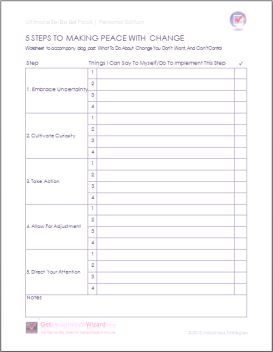
5 Steps To Making Peace With Change
1. Embrace Uncertainty
Rather than denial, open yourself up to not knowing how things will turn out. Denial is psychologically exhausting, but acceptance can be too great or too fast a leap.
Instead, aim simply for an absence of expectations, a vacancy. It can be both an uncomfortable and a liberating feeling.
EG:
- I don’t know what will happen with my job
- This relationship might work out, it might not.
2. Cultivate Curiosity
Curiosity is the anti-anger emotion – it’s impossible to feel both at the same time. (Try it next time you’re having a hissy fit; start asking yourself questions and watch the anger dissipate).
Aim to replace angry, railing thoughts with ‘I wonder’ thoughts: I wonder what will happen; I wonder how this will turn out. Don’t rush to answer, but be open to answers if they come.
EG:
- I wonder what other jobs I’d enjoy and be good at
- I wonder how I can be more valuable to my boss
- I wonder who else might be in my future
- I wonder how my life might be different.
3. Take Action
Focusing on things you can’t control keeps you stuck in denial, frustration, and anger – and leads you to despair as you become exhausted by all that pointless emotion. Instead, taking action can break you out of the cycle.
Shift your focus to what you can do – either to prepare for the change, or cope more effectively after it.
EG:
- I’ll ask my boss what I can do to make a better contribution
- I’ll take a class to improve my skills
- I’ll update my CV
- I’ll go out with my friends more, so I don’t feel so dependent on my relationship.
4. Allow For Adjustment
The greater the change, the more likely it is that you’ll need time for your emotions to settle. People are remarkably good at adapting to change, both good and bad, though, so rest assured that you will adjust.
Allow yourself some time to find a new equilibrium, and you’ll likely short-circuit the drama, despair and depression.
EG:
- It’s not what I’d choose, but it might end up being okay
- Things will settle down
- I know people get used to things, I’ll get used to this too.
5. Direct Your Attention
Once you’ve allowed yourself to tolerate uncertainty, then turned your mind to curiosity, taken action, and allowed a little time for adjustment, you can move on to the attention phase.
This is where you consciously direct your attention where it serves you best. You’ve done what you can, now it’s time to put your energy where reality is.
This could mean making the best of a change that’s out of your hands, or finding something new to replace something lost, or venturing into unexplored territory.
EG:
- I no longer have my old job: I’m going to search for the best new job for myself
- Now that I’m in this department, I’m going to focus on finding the good things here for me
- My relationship is over: I’m going to enjoy my friends and develop new hobbies and interests.
Get The Worksheet
Download the 5 Steps To Making Peace With Change Worksheet:
[wpdm_package id=’34951′ template=”53eea12a84963″]What Do You Think?
Could these steps help you deal with a change you don’t want and can’t control? Please share your thoughts!
[Image:by David Reece]

Apesar de não ser assumido, eu era gay e ele, hétero. http://www.freedomcarewarriors.org/blog/groups/a-fila-anda/
What To Do About Change You Don’t Want, And Can’t Control @MicheleConnolly http://ow.ly/20kEZ
What To Do About Change You Don’t Want, And Can’t Control | Get Organized Wizard http://ow.ly/1XURv
★ New Post ★ What To Do About Change You Don’t Want, And Can’t Control: http://bit.ly/d06Ov8
RT @MicheleConnolly What To Do About Change You Don’t Want, And Can’t Control http://bit.ly/9PKaUO
Get Organized Blog | What To Do About Change You Don’t Want, And Can’t Control:
Lately I’ve been thinking about c… http://bit.ly/d06Ov8
Pingback: Happiness Strategies | How to be Happy » What To Do About Change You Don’t Want, And Can’t Control